Wednesday, January 19, 2011

Video Games!

This year the library is going to start offering something we have never offered before. Starting this year we will be providing video games for checkout. The plan is to have games for the three big systems. Wii, Playstation 3 and Xbox.

We will have games from all different ratings. The rating system is shown below. They will range from Early Childhood to Mature (language and violence - war games)

*They are going to checkout just like DVD's do now.
*You have to be 14 to check one out.
*You will need to be 17  to check out anything with a mature rating.
*At first we will let you check out one at a time until we get more, then we will raise it to 2.

*You can have them for two weeks


There is NO CHARGE for this but remember just like everything else if you lose it or damage it you will have to pay the replacement cost. This can be up to $50 for some of the newer games. Please take care of them. 

We like to provide the kinds of things that you guys want. So help us out by taking care of the games so that we can build up a good collection. 

Here is where I need your help. I need you to tell me what kind of games you would like to see, even specific titles. We are going to try to get this started soon and be in full swing by Spring. 


So....please let me know! You can comment here or if you would rather email me at webmaster@owenlib.org


EARLY CHILDHOOD
Titles rated EC (Early Childhood) have content that may be suitable for ages 3 and older. Contains no material that parents would find inappropriate.
EVERYONE
Titles rated E (Everyone) have content that may be suitable for ages 6 and older. Titles in this category may contain minimal cartoon, fantasy or mild violence and/or infrequent use of mild language.
EVERYONE 10+
Titles rated E10+ (Everyone 10 and older) have content that may be suitable for ages 10 and older. Titles in this category may contain more cartoon, fantasy or mild violence, mild language and/or minimal suggestive themes.
TEEN
Titles rated T (Teen) have content that may be suitable for ages 13 and older. Titles in this category may contain violence, suggestive themes, crude humor, minimal blood, simulated gambling, and/or infrequent use of strong language.
MATURE
Titles rated M (Mature) have content that may be suitable for persons ages 17 and older. Titles in this category may contain intense violence, blood and gore, sexual content and/or strong language.

Monday, January 10, 2011

Something Fun

I sincerely hope that everyone had a wonderful holiday season, and is now the better for it. Holidays and family are great! I will admit to being a little ok with the season being over though. I got pretty exhausted between all the fun, excitement, and good times.   
I wanted to talk a little about picture books.  It is believed by many that picture books are for little kids, and have no further use.  While this may be true with some, it is most certainly not the case with all.  There are many, many picture books that have complex ideas and subject matter that the little ones simply will not get.  Not to mention words that are downright hard for even second or third grade readers.  This is why we have decided to call our picture book section “Illustrated for Everyone”.  Please, never discourage your child (or yourself) from reading picture books.  Your imagination and inner self will thank you.

I wanted to post on Neil Gaiman's picture books, well, some of them at least. LOVE them. If you saw the episode of Arthur that he did, you heard a snippet of Instructions, which he did with Charles Vess. Wow. This is SUCH a "Me" book. This is a beautiful and poetic look at how to get through life, or any fairy tale. I have learned that there are those who believe in magic, and those who don't. To each their own, I am definitely a believer in magic. Therefore this book is amazing to me. So beautifully written and illustrated, it is the kind of book that I want to own and read often. I want everyone I know to read it, even though I know many of them won't. *Sigh* Sad but true reality.

The first picture book of Mr. Gaiman's that I "discovered" was The Day I Swapped My Dad for Two Goldfish.  It was the first Neil Gaiman book I had ever read. Needless to say, I was hooked. This is a delightfully fun story of a boy who....well, read the title. All his Dad does is sit and read his newspaper anyway, so why not? His mother is not amused, however and makes him take his little sister with him to swap back. The problem is the boy with whom he has swapped has already swapped Dad for something else. The result is a swapping extravaganza until finally everyone has what they started out with and the boy and his sister have their father back.

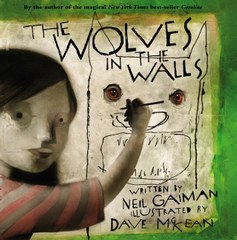
 Another favorite that I want to post here about is The Wolves in the Walls. Oh goodness do I love this book! Partly because it has a definite Neil Gaiman feel about it, which means humour and British-ness and things strange and wonderful presented in a matter-of-fact way, and partly because I think I may have wolves living in the ceiling of my bathroom.

Lucy knows that the sounds and creepy watched feeling she experiences in her "big old house" is due to the fact that wolves are living in the walls, but her Mom says it is mice. Dad says it is rats, and her brother hopes it is bats. Couldn't be wolves, because you know what they say: "if the wolves come out of the walls, it's all over." I have read this book recently to kids ranging in age from 4 to 11. They all enjoyed it. That is one of the great things about a well done "children's book"; they can entertain everyone. Just another reason why one should never stop reading picture books.

I often wish that books didn't have to be labeled and classified. A good story is a good story, who cares what age group it is aimed at? Exceptions do apply, I suppose. Still, if anyone sees you with a great picture book, never be ashamed!

I know everyone has heard of, if not seen Coraline, but not as many know that it was written by Neil Gaiman. Also, Stardust, which is aimed a bit older, is very good.   Other great Neil Gaiman books for all ages are the Award winning The Graveyard Book and Odd and the Frost Giants.   Great storytelling.

I just today ordered several more titles for our library's digital collection. I'm looking forward to more stories from this amazingly talented author. The above titles should by no means be considered a complete summation of his work, only a part of his books for children (with the exception of Stardust). He writes for all ages, and I'll get around to some of the others as well.....sometime. (This could be considered a tribute in honor of his recent wedding, if not for the fact that I had been planning it for a while......)

~Jennifer

Tuesday, December 7, 2010

Shared Reads

I was interested on who was the only other woman besides Leslie Van Houton on Death Row anywhere in the United States when the Supreme Court invalidated the death penalty as it existed in 1972 and with one stroke of the pen reduced the sentences of hundreds of men and two women to something less than the ultimate penalty. Leslie Van Houton, former member of the Manson Family who took part in the murders of Rosemary and Leon LaBianca, remains in prison almost 40 years after she was convicted. The other woman went free many years ago.
I first came across this factoid when reading an interview with John Waters who was promoting his recent book Role Models in which he recounts his relationship with Van Houton and I was reminded of it again when I ordered Mr. Waters book for the Library collection. The other woman was not named and I could not uncover her in a Google search and I wondered who this other woman was, what had brought her to death’s door, under what circumstances was she released, how did she live the rest of her life?
So I was thrilled when I came across Back From The Dead: One woman’s search for the men who walked off America’s death row by Joan M. Cheever. Unfortunately that thrill soon turned to disappointment. Sure I was warned by the title that it was about the men on death row but I thought certainly with only two women on death row in 1972 they would be mentioned by name. They were mentioned, but not by name and the book, rather unforgivably, does not include an appendix of those who were on death row in 1972 so my desire to know more about the elusive other woman remains unfulfilled.
Still, it should have been the sort of book I typically enjoy but as I was reading I came to believe that this book isn’t really the book Ms. Cheever wanted to write. I think she wanted to write about her childhood and growing up in Texas and about her parents, especially her mother, and we see glimpses of that book in this one.
Before authoring this book Ms. Cheever spent nine years defending Walter Williams on appeal from his sentence of death. Mr. Williams had murdered convenience store clerk Daniel Liepold in 1985. Mr. Liepold was uncomfortable working nights in one of the most dangerous professions in America. He had given notice to the store and was working one of his last three shifts until Mr. Williams, who had previously worked with Mr. Liepold, came in and made it his last shift. Both were nineteen years old at the time. Mr. Liepold had considered Mr. Williams his friend.
Ms. Cheever wasn’t looking to take on a death penalty case. She didn’t even intend to practice law anymore after a short stint on the Court of Criminal Appeals in Texas. She had gone back to school and earned a Master’s Degree in Journalism from Columbia University and was looking for a job as a reporter when she, a self-described “death penalty junkie” was sucked into the case.
I think this is what Ms. Cheever wanted to write about – her nine years defending Walter Williams, the fear that she would lose, the fear that she would be responsible somehow for her client’s death, and when the inevitable came, how she watched a man die, but that but isn’t here and I can imagine an editor shooting down the subject, Williams was some punk who a crime that is mundane to anyone not personally involved. It’s too boring. It has no hook. So instead Ms. Cheever’s hook is to trace the men released from death row in 1972 to see how their lives turned out but Ms. Cheever fails to deliver on this promise as well. What we are left with is Ms. Cheever’s Fear and that Fear permeates this book. Fear of meeting Walter, fear of failing Walter, Fear of contacting ex-convicts, fear of shady neighborhoods, fear of hotel rooms,
 The first convict Cheever contacts is man named Robert Hayes who was convicted in 1971 at age 19 for participating in a botched robbery attempt that ended with his accomplice murdering a police officer during a botched robbery in 1971. Mr. Hayes had been released from prison in 1990 and was working as a crisis counselor for low-income women in New York City. Ms. Cheever does not question him on his description of the attempted robbery of Joes Confectionary in Queens as “Robin Hood-esque” which is an off-putting way to start. She meets Chuck Culhane who took part in an escape attempt in 1968 which a deputy was murdered and who was paroled in 1992. Mr. Culhane teaches criminal justice at a college in Upstate New York for $100.00 a week. She meets with Calvin Sellars who was on Death Row in Texas for armed robbery, one of only four men in the Country on Death Row at that time, the other two being fellow Texans and one Georgian, all dead by 2005. She meets with William “Rusty” Holland who was sent to Death Row in South Carolina for the 1970 murders of two members of a rival motorcycle gang and the attempted murder of two women associated with the victims. He spent 11 years in prison before being paroled. He started a ministry, married twice, managed to obtain three Subway sandwich franchises and manage a Bingo parlor after his release. He wouldn’t meet with Ms. Cheever until she promised her book would “Focus on Jesus Christ.”
She meets with two men, Freddie Pitts and Wilbur Lee, who were found to be factually innocent by the state of Florida. She interviews an 88-year-ols man, Moreese “Pops” Bickham, who spent 38 years in Angola Prison, often digging graves for fellow prisoners who died behind bars, before being paroled in 1996. Mr. Bickham murdered two deputies, in self-defense, he says. He was 41-years-old and out on the town with his girlfriend, Florence, in 1958 when deputies were called to a bar where a scuffle had broken out. Bickham claims one of the deputies had threatened to kill him and returned later with reinforcements to make good on that threat although Bickham’s brother-in-law testified at trial that Bickham had threatened to kill one of the deputies, Gus Gill, for messing with him in the past but Bickham maintains his brother-in-law was intimidated into testifying by the local KKK. What seems most amazing is that Mr. Bickham was married at the time he was gallivanting around with Florence and that his wife, Ernestine, waited for him the entire time he was in Prison. It would have been interesting to hear Ernestine’s perspective but Ms. Cheever doesn’t bother to ask. She is threatened by an ex-inmate and is so fearful she hides his identity in her book.
She finds Elmer Branch in Connecticut whose case, alongside that of Henry Furman, went before the Supreme Court back in 1972. He was on death row for the crime of rape and when Cheever finds him he’s back in jail awaiting trial for allegedly exposing himself to a 14-year-old girl, one of seven children belonging to his live-in girlfriend, a woman who is herself on parole for murdering her husband. Cheever even locates her Holy Grail, enry Furman, the man whose name is attached toHenry Furman, the man whose name is attached to the Supreme Court ruling Furman v. Georgia that found the death penalty as it then stood to be unconstitutional. Furman had murdered a homeowner as Furman burgled the victim’s home in the middle of the night.
Along the way Ms. Cheever misses out on an invitation to witness the execution of serial killer Kenneth McDuff, a man who was suspected of killing 14 people after he was released from prison in 1986 after being convicted of the triple homicides of an 18-year-old and two 16-year-olds in 1966. Within three days of his release he killed again. Cheever does devote a chapter to men who have killed again after escaping Death Row in 1972 but she doesn’t actually contact any of them. She misses McDuff’s 1998 execution because she wakes up with a fever of 102.
Perhaps the saddest, and most interesting, part of Ms. Cheever’s book was when she tried to research Lester Eubanks who had been convicted of murdering a 14-year-old girl in 1965. After spared death in 1972 he went AWOL in 1973 after prison officials in Ohio gave him a pass to go Christmas shopping. When Ms. Cheever contacted officials in Ohio she was lectured and told Eubanks was in prison where he had been for a very long time. It turns out that the prison officials were wrong. Eubanks had never been captured. In fact, Eubank’s mother had recently died and Lester Eubanks was listed as a survivor, living in Columbus. Ohio.
So Ms. Cheever ended up speaking with seven men from the “Class of ’72” - hardly a representative sample and just a snapshot at best. Some of the men, like Robert Hayes, sent back to prison for a parole violation, experienced significant setbacks by the time the book was completed.    
A lot has changed since 1972. After the Supreme Court’s decision States worked to correct the flaws noted by the Court. No longer could a person be sentenced to death for rape or robbery, a distinction recently reaffirmed when the Supreme Court ruled in 2008 that the death penalty for the rape of a child is unconstitutional, and a jury had to consider possible extenuating circumstances. The Supreme Court re-affirmed the basic constitutionality of the death penalty in 1976 with the ruling in Gregg V. Georgia and the first execution carried out after Gregg was Gary Gilmore who was electrocuted in January, 1977 after waiving all appeals. In 1972 some 589 people sat on Death Row in the 50 United States, Currently 37 states have adopted a penalty of death and there are 3,261 people awaiting judicial execution. Since 1976, and As of December, 2010, 1,233 people have been executed for murder since 1976, twelve of them female. As of January 1, 2010, there were 3,261 people on death rows across the nation but more have been added and 44 subtracted so far this year. Currently 60 women are under sentence of death in the USA.
In all this book reads like an act of atonement by Ms. Cheever to Walter Williams. It reads like a plea to consider redemption and rehabilitation and all the reasons the death penalty is as unfair and arbitrary today as it was back in 1972. I wish I could recommend it without reservation but it just never rises to its potential.

~ Laura Wilkerson

Monday, November 15, 2010

Shared Reads

First off, I’d like to state that The Lampshade by Mark Jacobson is a beautifully designed book. The cover, before it was laminated, was thin and translucent, like parchment, and slightly greasy to the touch, very disconcerting, given the subject of the book. Visible through the cover is the titular Lampshade. Suspended as if floating against a black background the Lampshade looks like many others that might be found on a wooden floor lamp from the 1930s, a common shape, somewhat worse for wear, with a ragged band of tatty rick-rack running along the bottom edge. It is the very illustration of the phrase “banality of evil” so kudos to Jackie Seow for outstanding work in graphic design.
The Lampshade lays before the Reader the implicit question, “What would you do if you came into possession of a lampshade made of human flesh?’ The Lampshade washed up in detritus of Hurricane Katrina and landed in the hands of a notorious New Orleans grave robber who sells it at a yard sale for $35.00. The new owner, haunted by nightmares that left him unable to sleep, within a few days contacts the author, a journalist whose own Jewish grandparents had left Europe before the Holocaust, and he pays $17.00 for a half-interest in the item and shortly thereafter finds himself in possession of the Lampshade.
What would you do if you suddenly found yourself in possession of such an item? What the author does is spend five thousand dollars of his own money to have DNA testing done to the Lampshade. This confirms that the Lampshade is made from human flesh and sets the author on a quest to mine a deeper meaning from this object, a quest that takes him from the U.S. Holocaust Memorial Museum, where he is told that the Nazi lampshades made from human skin are a “myth” and that even though DNA proved it was human they couldn’t prove it to be from the Holocaust, it may well be one of Ed Gein’s, to Holocaust deniers, to skinhead youth in Germany, to people who had participated in the Nuremburg Trials, where a lampshade made of human skin was displayed on the “Buchenwald Table,” to an unsuccessful attempt to locate the son of Ilsa Koch to a successful attempt to meet with David Duke who has relocated from Louisiana to Austria.
The author travels from Louisiana, New York and Washington D.C. before traveling through Germany and on to Israel, Palestine, and Jerusalem, meeting with scholars, Rabbis and Mediums before deciding that maybe instead of Myth, the Lampshade, like the similarly contested rendered soap, is Mythic.
This is an excellent book that packs a lot of philosophical punch into a quick, engaging read. I would highly recommend it to anyone who is not squeamish about the subject matter. In addition to the wonderful design and deeply engaging text, this volume boasts detailed footnotes and an excellent index, something sorely lacking from many books making this book an uncommon pleasure from start to finish.
~ Laura Wilkerson

Friday, November 5, 2010

Our Heroes' Tree: Honoring and Supporting Veterans

Today marks the beginning of a month-long tribute to veterans.  The Military Family Research Institute at Purdue University partners with libraries around the globe to present the "Our Heroes' tree initiative.  This program enables libraries to honor past and present members of our U.S. military, all branches and all wars.
 

Everyone who wishes to is invited to place an ornament (or ornaments) on the tree to honor their loved ones.  Please make as many as you'd like.  You can use the templates supplied by us here at the library, or create your own.  These can include photos, or not.  

We are pleased to offer two separate Heroes' Trees here at OCPL this year.  One is located on the main floor, and one on the second floor, in Youth Services.  If you have any questions, please call the library, or contact us via e-mail, a comment here, or facebook.  We are happy to answer your questions if we can. 

Our Heroes' Trees will remain up through out November, and into December.  If you would like your ornament back at the end of our display, please come in and feel free to pick them up beginning December 5th.  Thank you in advance, and we hope to see many ornaments in support of our men and women who have served, or are currently serving our country.  Now, I'm off to make mine.....

Thanks again,

~Jennifer

Friday, October 15, 2010

Shared Reads

After reading the excellent Poisoner’s Handbook by Deborah Blum I was left wondering how the United States of America got involved with anything so boneheaded as Prohibition. Luckily, Daniel Okrent, former public editor of the New York Times, has written a book, Last Call: The Rise and Fall of Prohibition that asks, and answers this very question.
Prohibition was a project 50 years in the making and at one time the prohibition of alcoholic beverages must have seemed a mind-boggling proposition. The United States was a Nation founded on rivers of alcohol. The armed services were issued rations of alcohol and it was a common sight to see farmers in the field with a jug of alcohol strapped to their mule. Early on in the Republic there was a call for Temperance, meaning moderation. By 1840 Evangelical Christians took up the call for voluntary abolition achieved through education and persuasion and successfully lobbied for Scientific Temperance Instruction, the D.A.R.E. of its day, to be made compulsory in public schools across the nation, creating, in the words of activist Mary Hunt, “Trained haters of alcohol.”
 Victorian sensibilities were worked into high dudgeon over the perceived ills that alcohol caused society and anti-alcohol propaganda exploded. In one of the most popular plays of the 19th century, Ten Nights in a Bar Room, alcohol was portrayed as causing suicides, murders and early childhood death and popular songs carried such titles as Don’t Sell My Daddy No More Wine and Total Abstinence Round.
An explosion of Progressive fervor carried over from Abolition and the Civil War was also in play. Universal suffrage, granting women the constitutional right to vote which they had in some states but not in others, mobilized thousands of women, many of whom were drawn to other progressive causes such as ending child labor and prohibiting alcohol. The Women’s Christian Temperance Union (WCTU) became a powerful mobilizing force, so much so that the Beer Barons paid rural newspapers to run editorials against universal suffrage, but it was really the Ohio born Anti-Saloon League (ASL), under the leadership of the brilliant political strategist, Wayne Wheeler, where Prohibition gained traction.
 By voting as a solid 10% block on a single issue the ASL could deliver a political race on the margins. Beyond uniting Progressives such as Jane Addams along with Industrialists like Henry Ford and the likes of Henry Ford with labor unionist Wobblies; it allied religious groups, primarily Baptist and Methodist, with the stridently Nativist and newly reconstituted Ku Klux Klan whose target in the early 20th Century were largely Catholic and Jewish immigrants who were believed by many to be taking over the country and diluting the lifeblood of “pure” America. WWI rendered the Germans a much maligned group in America and defanged any effectiveness that the Beer Barons, who had rejected an allegiance with the hard liquor distillers on the grounds that beer was healthful and good while hard alcohol was bad and un-healthful, had at that point. They say politics makes for strange bedfellows but I have always personally believed that when you start waking up with strange bedfellows it’s time to start re-evaluating your life choices.
Timing played a huge success in the passage of Prohibition as well. The Constitutionally mandated Census would be coming up soon and population shifts from rural areas to urban areas and an immigrant birthrate that was much higher than that of the pre-existing population did not favor the Dry cause. As it played out, ASL backed Legislators managed to fend off the new Census until 1928 and it was only at the point where the delay endangered the very Constitutionality of the elected Federal Government and all its works and issue was the Census finally conducted and congressional seats reapportioned to correct some of the inequity created when one Legislator might represent 19,640 citizens while another might represent 652,089.  
It also took the 16th Amendment to make the 18th Amendment possible. There had been income taxes imposed in the past to fund wars but these had been temporary and in 1895 the Supreme Court struck down an income tax imposed on profits from stocks, bonds and real estate investments by Congress as unconstitutional. It took Congress until 1909 to craft the language of the 16th Amendment allowing for the collection of income taxes by the Federal government and submit it to the States with ratification complete in 1913. One of the most compelling arguments in favor of the Amendment was that revenue raised through income taxes could replace income generated through alcohol taxes. Before the income tax the Federal government raised revenue primarily through two sources, taxing alcohol and tariffs imposed on foreign goods imported into the United States. In 1910 taxes on alcohol produced $200 million in federal revenue, fully 71% of all internal revenue of 30% of all total Federal revenue.
In 1910 a Constitutional Amendment failed to get out of Congress on a 197-190 vote with 2/3rds of the affirmative votes cast by representatives who came from towns with less than 10,000 people. This vote energized the Prohibition base who made the elections of 1916 of paramount importance. Their success in this endeavor led to the House of Representatives submitting the 16th Amendment to the States on December 18, 1917 and it was ratified by the needed 36 States in  just 394 days, half as long as it took 11 States to ratify the Bill of Rights. Okrent points out that Mississippi ratified in just 16 minute2 on January 8, 1918 while it didn’t get around to ratifying the 13th Amendment, the one abolishing slavery, until 1995. Ratified in 1919, Prohibition became the Law of the Land on January 17, 1920.
Prohibition of alcohol then turns into the story of the dog who chases the car and then catches it. What to do next? Prohibition didn’t outlaw the manufacture of alcoholic beverages for personal use and exceptions were made for sacramental wine used in religious services for those of Roman Catholic or Jewish faiths. Medicinal alcohol was allowed by prescription and some saloons converted themselves into pharmacies.
The Volstead Act provided enforcement be shared between the Federal government and the States but the money allocated for Federal enforcement was miniscule compared to what the need would turn out to be and many States had no interest at all in enforcement and it was enforcement, ironically, that helped bring Prohibition to an end. People rebelled against the expansion of government police powers. They were horrified by Supreme Court decisions that allowed the government to wiretap private telephone conversations, a ruling that stood until 1967, and to stop and search private automobiles without warrants or probable cause. Draconian laws were passed at the Federal level whereby low level sellers of alcohol could be jailed for life while the wealthy drank openly without much consequence at all. Soon juries began practicing nullification by refusing to convict those whose punishments seemed more outsized that the crime. Deaths, along with blindness and other disabilities, soared with the production of poisoned alcohol and the official response was to make ingredients more deadly and to blame drinkers who refused to follow the law for their own predicaments, a position that alienated many.
Another death blow to Prohibition was the literal death of Wayne Wheeler of the Anti-Saloon League in 1927. Two weeks before his death at age 57 his wife, Dorothy, caught on fire. She ran clothes aflame, into the living room where her father was recuperating from a heart attack. The old man, seeing his daughter on fire, pitched forward and died on the spot. Mrs. Wheeler died from her injuries the next day.
Wayne Wheeler devoted 34 years of his life to the ALS and after he died a schism occurred between forces who wanted to enforce Prohibition through laws and punishment and another faction who wanted to advance a voluntary acceptance of abstinence from alcohol through education and encouragement. The forces of law and punishment won that battle but were already losing the war as evidenced by the firing of Prohibition’s staunchest Federal enforcer, Assistant Attorney General Mabel Willebrant in 1929.
Into the vacuum created by the death of Wayne Wheeler and the resulting infighting among varying ALS factions, stepped the Association Against the Prohibition Amendment, previously a powerless and little known entity revitalized in 1929 by Pierre DuPont and 69 other concerned Captains of Industry. What these Captains were specifically concerned about was taxes. Since the passage of the Revenue Act of 1916 the tax rates among the highest brackets had doubled, the first peacetime inheritance tax had been implemented, and a 12.5% tax on profits from munitions manufacturing had been instituted.
Then came The Great Depression, triggered by the stock market implosion of 1929 and extended through a series of disastrous economic decisions. Tax revenue plunged 60% in three years and the capital gains tax dropped into negative territory. Unemployment soared above 25%. Al Capone opened a soup kitchen. The demand for stimulus spending by the Federal Government rose and in 1932 the American people voted out President Herbert Hoover, the Republican President who had promised “a chicken in every pot, a car in every garage” when he had ran in 1928, and replaced him with Franklin Delano Roosevelt.
FDR had been a supporter of Prohibition in his earlier career but in the election of 1932 he ran on the Democratic Plank of Prohibition Repeal and in February of 1933 the 21st Amendment to the United States Constitution was submitted for Congressional debate. FDR was sworn in as President on March 4th and on March 14th a bureaucratic change in the definition of “intoxicating” allowed liquor containing up to 3.3% alcohol by weight to be sold.
The economy responded incredibly well to this sort of stimulus and a variety of businesses from trucking firms to ice houses to coopers hired thousands of new employees. Budweiser purchased its first pair of Clydesdales.
Congress voted to submit the 21st Amendment to the States for ratification and on April 10, 1933 Michigan became the first state to ratify and on December 5, 1933 Utah, somewhat ironically, became the 37th needed state to ratify and suddenly The Noble Experiment was over.
In 1934 the Federal government collected $258,911,332 in alcohol taxes, 9% of the total overall budget. This boon did not, however, signify a tax cut for the DuPonts of the world. FDR used the windfall to subsidize tax cuts for workers earning between $2,000 and $3,000 dollars a year, or about $31,700 - $47,500 in today’s dollars, and toward the implementation of new government programs, including Social Security, in the second half of his 1st or 4 terms.
Last Call is probably best when recounting the maneuvers that led to Prohibition becoming law in the first place and the author packs a lot of perspective in a not-too-weighty tome. One perspective I do miss, however, is the perspective of the average American. I got more of a feel for the real suffering Prohibition caused among average working Americans from The Poisoner’s Handbook even though the issue of Prohibition is not the main focus of that work. Occasionally Okrent will provide a quote from a newspaper editorial but the book doesn’t have the depth needed for such an analysis.
It’s still hard to believe that anybody ever thought prohibition would be a good idea or didn’t see what ended up happening as inevitable. Here’s a story that didn’t make it into Last Call: Before Prohibition became the Law of the Land with the passage of the 18th Amendment, twenty-seven of the forty-eight States had already voted themselves Dry and even in Wet States there could be Dry Counties and even Dry Towns. In 1908 Licking County Ohio voted to go Dry much to the disgust of the County Seat of Newark, which had voted to stay Wet. Newark defied the law and saloons stayed open with the help of graft and corruption. Prohibitionists were appalled by this and asked Wayne Wheeler’s Anti Saloon League for help and the League responded by hiring twenty private detectives, among them 17-year-old Carl Etherington of Kentucky who, despite his tender years, had previously been employed as a strikebreaker for the Baltimore & Ohio Railway. The detectives spent a few days gathering evidence at the local saloons which by law were only permitted to sell near-beer and soft drinks, and then with evidence in hand were deputized by the mayor of nearby Granville, Ohio and his Marshall, Edward Evans.
They newly minted deputies then returned to Newark with warrants to close down five illegal saloons. The Deputy Detectives first raided a saloon owned by Louis Bolton and beat with brass knuckles a bartender they found working there. The group of then proceeded to the Last Chance Saloon whose proprietor, William Howard, just happened to be Newark’s former, and very popular, Chief of Police. Howard and Etherington scuffled before Etherington drew his revolver and shot Howard dead. Etherington was arrested and taken to jail but that evening the crowd, which had grown to over 5,000 men, women and children, stormed the jail.
Realizing what was happening, Etherington tried to commit suicide. He first tried banging his head against the wall and when that failed he wrapped his jacked around his head and set it on fire. He was rescued by the mob before he suffocated and was taken from the jail and beaten brutally and shot at before a rope was procured and Carl Etherington was strung up from a telephone pole on the corner of South Park Place and 2nd Avenue in downtown Newark. His final words were, “I want to tell all young fellows not to make a living the way I have done – by strikebreaking and taking jobs like this. I had better not have worked or I would not be here now.”
What could have possibly gone wrong?
I would recommend this book to anyone who has an interest in political process, American history or prohibition policy. It may be of particular interest to the fans and followers of the HBO series Boardwalk Empire which is itself is based on the book of the same name by Nelson Johnson, also available for checkout at the Owen County Public Library. It is not a deeply engaging book so it is not a particularly quick read but it is a worthwhile effort so check it out!   
~ Laura Wilkerson
   October 15, 2010

Friday, October 1, 2010

Fall Has Fallen

October already. Time sure flies. This promises to be a busy month with festivals across the state, Halloween activities, harvesting and such. It is that busy, readying for winter time of year. The library is no exception to this.

Start off the season with an afternoon of Celtic fiddle music.  Friday, October 8th OCPL has the privilege of hosting musician Emily Ann Thompson.  "Emily Ann Thompson’s Celtic fiddling is lively, passionate, and homegrown with an American flare. She plays traditional Irish, Scottish, and Cape Breton tunes in highly energetic and original arrangements."  (from her website)  She will be accompanied by guitar as well.  This will be a musical treat for all ages, and will take place on the main floor of the library from 3:30 until closing at 5.  We hope you can join us for this fun, energetic performance.

Other fun things happening at the library this month include a Halloween Party (Thurs. Oct. 28th 6-7:30) and our Family Movie Night (Tues. Oct. 26th at 6 pm).  This month's selection will be How to Train Your Dragon.
 

For more information on these and other library happenings call or come in to the library, check out our website, or find us on facebook.  Happy Fall everyone!

~Jennifer